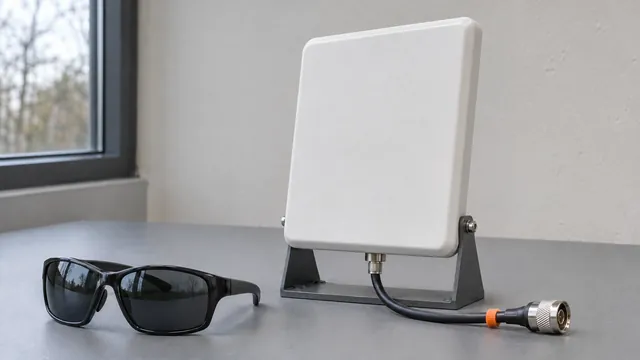
I have a confession. Years back, when a room full of half-asleep people stared at me waiting for an explanation of how LTE antennas work, I grabbed the nearest thing on my desk: a pair of sunglasses. Blazing afternoon sun, glare everywhere, then bam - polarized lenses pull all that scattered brightness into something your eyes can handle. That, right there, is gain. The entire trick in one object.
After enough years fiddling with radios and antenna arrays, I can promise you this metaphor holds up better than it has any right to. Light and radio waves sit on the same branch of the electromagnetic family tree, so borrowing eyewear logic to explain antenna behavior works absurdly well. I tell radio enthusiasts: "Your antenna is basically fashionable eyewear for photons with no manners." My hope is that by the last line of this piece, you'll grasp why gain matters if you're strengthening a 5G signal in your backyard, stretching Wi-Fi out to the garage, or bolting a GPS unit onto a delivery van.
What gain means once you strip away the jargon
Gain tells you how well an antenna funnels energy toward a favored direction instead of spraying it everywhere like a sprinkler with a busted head. One sentence. Tattoo it somewhere if nothing else sticks.
Where people stumble: gain is never power, and it's never range in some miraculous freestanding sense. An antenna cannot conjure extra watts out of nothing; it simply reshapes what the transmitter already hands it. Picture a bare bulb glowing evenly in every direction, dim and diffuse. Put sunglasses over it (stay with me) and the light suddenly punches harder along certain paths while fading elsewhere. The bulb's wattage never budged. The distribution did.
Higher gain, then, gives you a skinnier, more concentrated beam with more punch along that narrow corridor. Lower gain spreads the same energy thin and wide.
The eyewear comparison, taken further
Polarized wraparounds that kill glare from specific angles? Those are your directional antennas - Yagis, panels, parabolic dishes - engineered to hurl energy one way with genuine authority. Big tinted lenses covering your whole peripheral vision evenly? That's the omnidirectional antenna, blanketing 360 degrees in a donut of coverage, weaker per direction yet far more forgiving about where you happen to be standing.
When engineers throw around dBi or dBd, they're basically grading how dark the shades are - how strongly the antenna concentrates energy against a theoretical baseline. And just like sunglasses, setting decides if the choice is genius or foolishness. Ski goggles shine on a mountain and look absurd under a disco ball. Same principle: never point a high-gain panel antenna at your own living room router sitting three feet away. You'll end up with one narrow, blinding beam aimed squarely at your couch and next to nothing for the rest of the house.
The math, deliberately rough
Decibels exist because radio people got sick of multiplying minuscule fractions against enormous numbers, and logarithmic scales made link budgets tolerable. dBi means decibels relative to an isotropic radiator - an entirely theoretical antenna that spreads energy with mathematical perfection in all directions, which exists in no real hardware but serves as a tidy reference.
Numbers worth remembering: 3 dB roughly doubles power in the favored direction. 6 dB approaches four times. 10 dB lands near ten times. These run fuzzy at the decimal level, but for building intuition, they'll carry you a long way.
Here's a small link-budget scenario. Your transmitting antenna carries +6 dBi gain; the receiving antenna at the far end carries +3 dBi. Stack them (decibels play nicely with addition) and your link enjoys a combined 9 dB boost versus two isotropic references. That's the whole charm of decibels - gains and losses collapse into plain arithmetic instead of a multiplication headache.
One footnote: manufacturers sometimes print dBd instead of dBi, measured against a dipole antenna rather than the isotropic ideal. The dBd figure runs roughly 2.15 dB lower than the equivalent dBi number for the same physical antenna, so check which standard a spec sheet uses before comparing products.
Beamwidth, lobes, and the trade-offs you can't dodge
Beamwidth tells you how wide that focused cone of energy runs, measured where power falls to half its peak (hence "-3 dB beamwidth" on spec sheets). Skinnier beamwidth pairs directly with higher gain - the same energy squeezed into a tighter cone punches further along that axis, naturally.
Radiation patterns get sketched as blob diagrams: one dominant lobe aimed at the intended direction, smaller side lobes leaking off at odd angles, a bit like stray light bouncing off a lens edge. The trade-off bites hard. Focused beams buy serious range and demand serious aim. My favorite line on this: "It's elegant until a truck shifts your antenna by 2 degrees and the link dies." Ask me how I know.
Directional or omnidirectional for your situation
Omnidirectional antennas carry lower gain but blanket the full 360 degrees, which makes them the obvious pick for indoor routers, small cell sites, or anything with a moving user who can't babysit alignment all day.
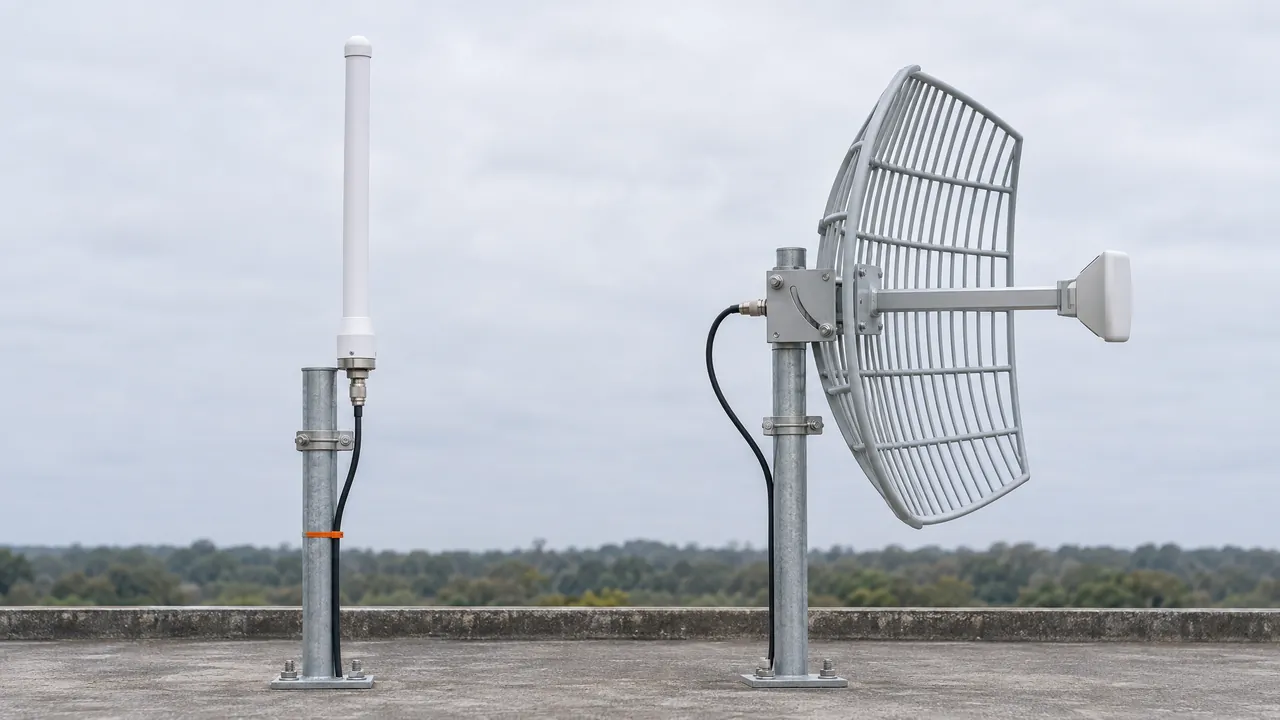
Directional antennas - Yagi, panel, parabolic dish - surrender that flexibility for genuine reach along a single axis. Ideal for point-to-point links, rural towers, or a fixed outdoor install that plans to stay put.
A quick checklist for people sketching a project: how much does the device move, how far must the signal travel, and how cluttered is the environment with walls, trees, or competing signals bouncing everything around?
Where you meet this in real hardware
Mobile signal antennas split cleanly along this line. A high-gain directional panel reels in a distant 4G or 5G tower for a rural property; an omnidirectional whip handles in-vehicle duty where the nearest tower's bearing shifts every time you turn a corner.
Wi-Fi follows suit. Long-range directional units handle outdoor backhaul between buildings, and omnidirectional access points serve a room of laptops and phones scattered in every direction.
Specialized antennas get pickier. GPS antennas run deliberately low gain since precision and consistent reception beat raw reach. IoT antennas get sculpted for whatever pattern their sensor network demands. Industrial and vehicle-mounted units go one way or the other depending on if they're tracking a fixed base station or broadcasting to whatever drifts nearby.
Picture an RV trip: an omnidirectional antenna married to a signal booster tames the chaos of constant motion. Now compare the rural homeowner bolting a directional 4G panel to the roof, aimed with monastic patience at a tower fifteen miles out.
Choosing gain for your own build or lab
Run a short mental checklist. Map the coverage area you actually need against the distance you're trying to span. Weigh obstructions - walls, trees, rival wireless traffic. Think about the physical size and mounting limits of whatever you're building. And remember regulatory caps on EIRP (effective radiated power) - cranking gain too far can push you over legal lines even with the transmitter's output untouched.
The flow: settle on coverage type first, omnidirectional or directional, then pick a gain level that balances beamwidth against the realism of keeping the thing aimed.
Testing gain without a professional lab
Students get surprisingly far with modest tools. Compare RSSI readings against a known reference antenna, or grab one of the antenna pattern viewer apps floating around for smartphones. Fair warning: free-space measurements and messy reality - walls, reflections, the occasional nosy squirrel - rarely agree. Take several readings before trusting any single figure, and respect regulatory and safety limits if you experiment with higher EIRP outdoors.
Myths that deserve retirement
Higher gain is never automatically better - narrow beams create alignment headaches that can swallow the range benefit whole. Gain produces no power from nothing; it only redistributes what's already transmitted. And dBi alone never tells the full story on a spec sheet - pattern shape, beamwidth, and efficiency matter every bit as much as that boldface number.
Closing the case
Antenna gain behaves exactly like sunglasses on a brutal afternoon: concentrate the same energy, aim it somewhere useful, accept the trade-off that narrowing your view costs you. People wanting hands-on practice should swap antennas and log RSSI differences, read manufacturer spec sheets with genuine attention to the pattern plots, and browse IMPAQ MSN's pages for specimens of antenna types named here. Now go pick your sunglasses - sorry, antennas - with some wisdom.