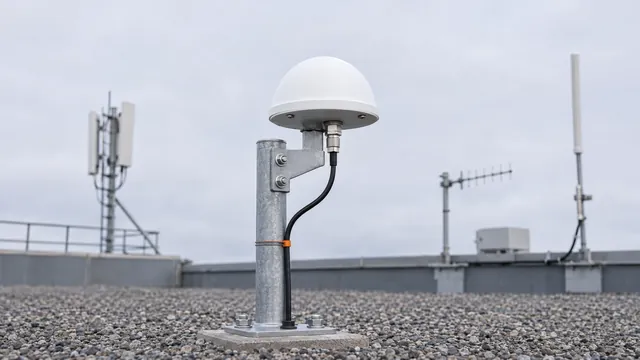
While you're slapping the snooze button for the third time, a squat little dome on some rooftop has been awake for hours, calmly informing the power grid, the stock exchange, and your nearest cell tower what time it is. No coffee, no complaints. It just drinks in signals from satellites circling 20,000 kilometers up and somehow converts them into timestamps accurate enough to stop financial markets from dissolving into anarchy.
Below you'll find how these antennas actually work, why they quietly hold up global timekeeping, and a handful of experiments for the sort of student who gets unreasonably worked up about nanoseconds.
The Two Jobs GNSS Does While You're Not Watching
Most people assume GNSS (the family name for GPS, GLONASS, Galileo and the rest) exists to plant a blue dot on your maps app. That's half the assignment, tops.
Positioning runs on trilateration: your receiver measures distances to several satellites and works out a location from where those measurements overlap. Timing is the quieter sibling. Every satellite lugs around an atomic clock, and receivers borrow that broadcast time to keep cell towers, trading floors, and countless other systems marching to the same beat.
Imagine the satellites as roommates who are insufferably punctual and silently disapprove each time you show up three minutes late. That's the energy.
The Hardware That Deserves More Credit
GPS antennas look dull. Little domes, little pucks, bolted to roofs. The guts inside them, though, vary enormously with the job at hand.
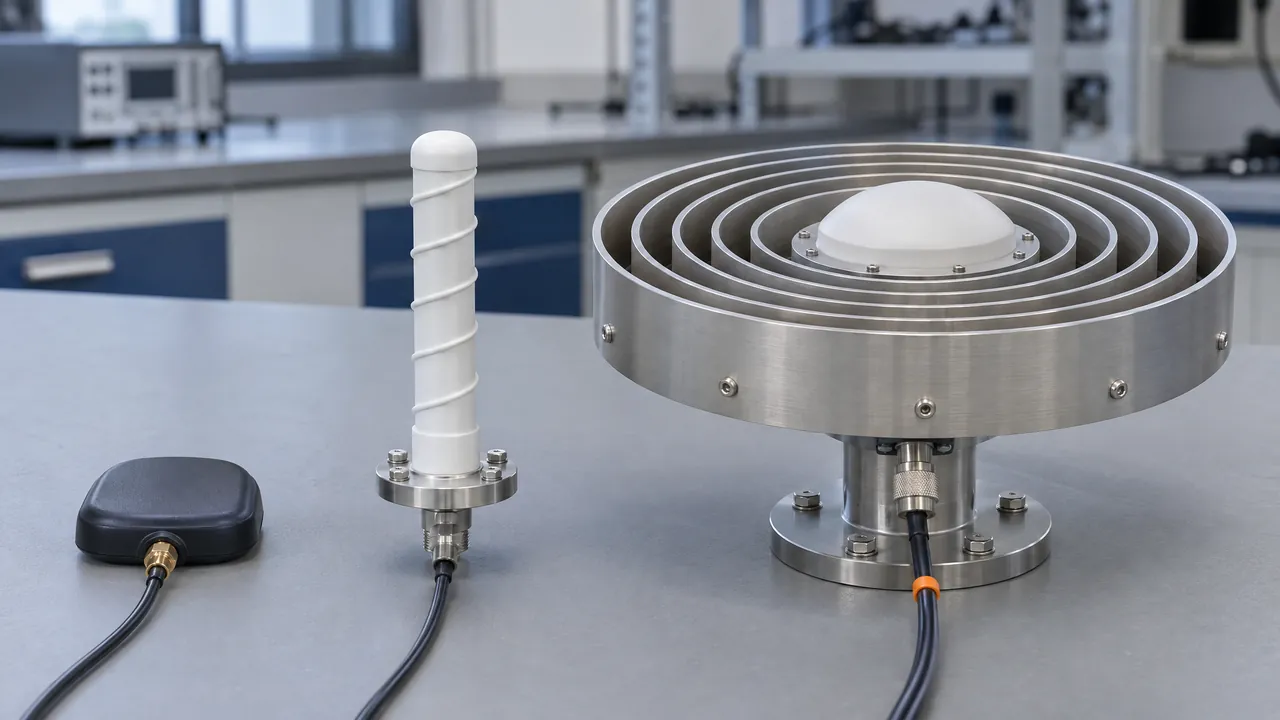
Patch antennas stay small and cheap, and they live inside phones and consumer trackers. For casual use, they get it done. Helical antennas offer omnidirectional reception and pop up in handheld units and vehicle mounts. And then there are choke ring antennas, the heavyweights, engineered for research-grade and survey work where multipath interference needs to be wrestled into submission.
What lands on these antennas is a spread of signals across multiple bands: L1, L2, L5, sometimes pulled from GPS, GLONASS and Galileo all at once. Multi-band reception earns its keep by filtering out atmospheric distortion and producing a sturdier fix.
A few specs to memorize before you ever shop for one. Gain tells you how well the thing amplifies a feeble signal. Axial ratio describes how cleanly it handles circular polarization. Noise figure measures the garbage it injects into the signal on its own. And phase center variation is the sneaky one, an error source that wrecks precision timing if you ignore it. Multipath (signals ricocheting off buildings or your neighbor's shed before reaching the antenna) is accuracy's mortal foe, and so is a poor view of the sky.
Jill's pro tip: want better GPS timing? Mount the antenna where it can actually see the sky, not where a tree is cosplaying as a blackout curtain.
The Timing Chain, No Physics Degree Needed
Here's the sequence. Atomic clocks aboard each satellite broadcast a time-coded signal. Your receiver grabs signals from several satellites, compares their arrival times, calculates the propagation delay, and solves for your position plus a correction to its own internal clock. What pops out the other end is a PPS signal, pulse-per-second, a ruthlessly accurate tick that other devices can sync against.
High-end GNSS timing receivers land within tens of nanoseconds of true time. Your phone, bless its heart, manages a few milliseconds on a good day. Sounds respectable until you do the math and realize that's roughly six orders of magnitude apart.
Cell towers lean on this chain to keep handoffs in step. Financial exchanges lean on it to timestamp trades to fractions of a second. Think of GPS time as the universe's group chat, where every single participant must agree on the minute. No exceptions, no "sorry, running behind."
Where This Stuff Quietly Runs Everything
Telecommunications: base stations need synchronized clocks to pass calls between towers without dropping them.
Power grids: phasor measurement units scattered across the grid need matching timestamps to spot instability before it snowballs into a blackout. Let the drift reach a few microseconds and operators lose all ability to tell what's actually happening across the network.
Financial markets: regulators demand trade timestamps precise to the millisecond or finer, partly to catch fraud and partly to keep high-frequency trading honest.
Autonomous systems and IoT: self-driving cars and sensor networks mash together data from many sources, which only works if every sensor agrees on when something happened. This is precisely the territory of specialized IoT antennas built for that kind of low-latency coordination.
Scientific research: geodesists use GPS time transfer to measure continental drift, watch earthquake fault lines, and calibrate instruments planted all over the globe.
If you enjoy math, a touch of controlled chaos, and the notion of personally keeping the grid from collapsing, go poke around timing engineering. Nobody at parties will have a clue what you do. You'll know, and that's enough.
Projects to Try Before Your Professor Assigns Something Boring
Project A: build a basic GPS logger. Grab a low-cost GNSS breakout board, a patch antenna, a microcontroller (an Arduino or ESP32 works), and an SD card. Log NMEA sentences over 24 hours and watch how the position and timing fixes shift depending on where you mounted the antenna.
Project B: measure PPS accuracy. Pair a GNSS receiver that outputs PPS with an oscilloscope or logic analyzer. Watch the jitter. Then compare it against your laptop's system clock. You'll come away with a gut-level feel for the gap between nanoseconds and milliseconds that no textbook hands you.
Project C: the antenna mounting experiment. Test signal quality and time-to-fix from a rooftop, a windowsill, and under a tree. Multipath and sky visibility stop being abstract vocabulary real fast. Do check your campus rules before climbing onto any roof, and don't broadcast anything you're not licensed for.
Buying an Antenna Without Spiraling Into Overthinking
A hobbyist logging weekend GPS data needs nothing near the gear a survey-grade geodesy researcher or an industrial site running vehicle-mounted GNSS for fleet tracking requires. But antenna lineup matters any time synchronization affects booster sites or base stations. Even the Wi-Fi antenna range gets a side benefit, since precise timing helps mesh networks coordinate without stepping on each other's toes.
A quick checklist before you spend money: band support, connector type, mounting style, environmental rating. Browse the catalog for starter kits if you're still getting your feet wet.
What's Coming Down the Pike
Multi-constellation, multi-band GNSS receivers are becoming the default, alongside stronger anti-jam and anti-spoofing defenses and tighter pairing with terrestrial timing protocols like PTP. The genuinely wild idea on the horizon: quantum clocks feeding into GNSS infrastructure, pushing timing accuracy into territory that would make today's nanosecond precision look quaint.
Some Quick Myth-Busting Before You Go
"My phone's GPS is fine for timing, right?" Fine for most apps. Nowhere near adequate for telecom or grid-grade synchronization.
"Can someone spoof my GPS antenna?" Sadly, yes. Spoofing and jamming are genuine threats, and pairing better antennas with anti-spoof technology helps push back.
"Are GPS antennas just tiny plastic domes?" Rude, and no. Choke rings and helical designs exist precisely because the humble dome can't handle precision work.
The Parting Shot
One small antenna on one rooftop keeps the grid steady, the markets honest, and your calls connected, all by agreeing on the time down to the nanosecond. So go build something, go read up, and go swing by IMPAQ MSN for info that'll get you off the ground.
Resources worth your evening: the U.S. GPS.gov beginner's guide, the NMEA 0183 reference docs, and any budget GNSS breakout board from your favorite electronics retailer.