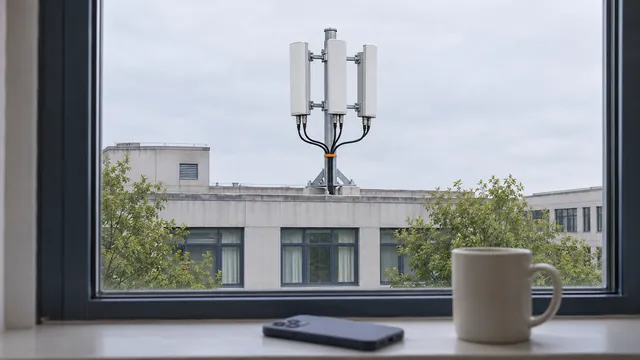
Three doors down from my old dorm lived a guy convinced his microwave devoured his 5G bars every time he reheated ramen at 2am. I've heard that theory, or some close relative of it, roughly four hundred times. The blame gets scattered everywhere: the microwave, the roommate's gaming rig, the foil poster of a koi fish, even a closed window that has apparently been promoted to signal-proof vault. I'm Jill. I design antennas for a living. Let me show you what's genuinely going on between your phone and the nearest tower, minus the mysticism. Bring snacks. Ramen is optional, though thematically on point.
Why should anyone care, given that your real priorities are problem sets and finding out if the dining hall still has fries at 9pm? Because a steady connection is the quiet hero behind every group project, every lecture-hall Zoom call where the professor insists on screen-sharing a 90-slide deck, every 3am upload of a paper due at 8. People treat wireless signal like folklore, something governed by moods and rotten luck. It isn't. It's physics with a schedule. Once the mechanics click, the mystery drains right out, and you stop negotiating with your router like it owes you money.
One thing to sort out first: "5G" is not a frequency, a cable, or a glowing orb living inside your phone. It's a generation of technology, and it spans three distinct flavors of spectrum. Low-band travels far and slips through walls but crawls at a pace nobody writes home about. Mid-band splits the difference, decent reach, solid speed. mmWave is blisteringly fast and comically short-range, the sort of signal that gets jittery around tree branches. These bands work like pizza sizes: mmWave is a slice loaded with so many toppings it barely survives the trip from counter to couch, while low-band is the thin, foldable slice that crosses campus without a complaint. Antenna engineers wrestle with this tradeoff daily, since the spectrum you're chasing dictates the entire shape of the hardware.
Antenna anatomy, briefly, since these terms get thrown around and you deserve to know what they mean. Omnidirectional antennas, the stick and tower types, fling signal in every direction, which makes them the workhorses of general coverage. Directional, or panel, antennas concentrate output into a beam, handy for reaching across distance or pulling in a weak signal from one specific tower. Massive MIMO arrays stack many small antenna elements together so a tower juggles dozens of connections at once without choking. Small cells and repeaters are the compact base stations bolted to buildings and lampposts, quietly patching the gaps big towers miss. None of this maps onto danger, by the way. A bigger antenna is just shaped to aim its energy somewhere specific.
Now the actual mechanics.
Radio waves are electromagnetic ripples, synchronized oscillations of electric and magnetic fields traveling at light speed. Frequency and wavelength sit in an inverse lockstep: crank the frequency up and the wavelength shrinks. An antenna has to be sized in proportion to the wavelength it handles, which explains why mmWave antennas can be tiny while low-band ones run chunky. It's resonance. The element has to "fit" the wave the way a tuning fork fits a particular note.
Radiation pattern is the shape energy takes once it leaves the antenna, and it's never uniform. Picture a donut of energy radiating outward for an omnidirectional unit versus a flashlight beam for a directional one. Gain, for all the word implies, doesn't conjure extra power from thin air. It squeezes energy into a narrower shape, the same wattage concentrated like sunlight through a magnifying glass instead of scattered across a field.
Beamforming is where 5G earns real cleverness points. Phased array antennas hold many small elements, and by adjusting the timing, the phase, of the signal leaving each one, the tower steers a beam electronically, no moving parts involved. A cell site can track your phone specifically instead of blasting signal in every direction and praying. Practically? Your connection holds up in a packed lecture hall, and your roommate's ranked PUBG match isn't hogging bandwidth meant for you.
MIMO, multiple-input multiple-output, runs several antennas at once to send and receive multiple data streams simultaneously, spatially separated so they never trample each other. This is exactly why dense environments, packed stadiums, crowded quads between classes, don't descend into digital chaos the way older networks might've.
And yes, materials matter. Walls, glass, your roommate's inexplicable foil poster collection, all of these attenuate or reflect signal to some degree. Polarization, the orientation of the wave itself, also shapes how efficiently a signal gets received. Nothing here "ruins" anything. It nudges the numbers.
Mythbusting time, quick and merciless. Microwaves operate mostly outside 5G's working bands, and stray leakage from a modern appliance is negligible. Fish tanks and foil decor cause minor local attenuation at worst, never network collapse. Closed doors and windows shave down signal strength, sure, but they don't break the antenna system feeding your building. Your lava lamp is no 5G assassin, no matter how suspicious its glow looks at midnight.
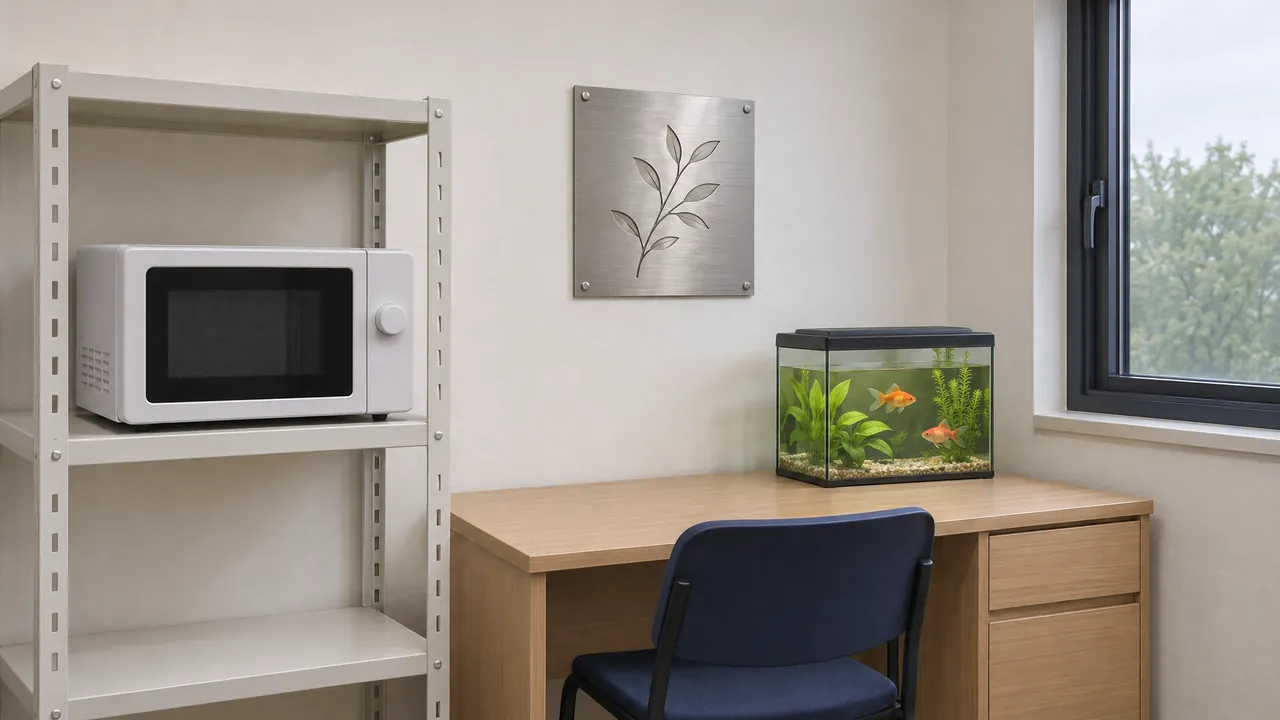
What can you actually do, ranked by effort? Move closer to a window, or toward the room's center where reflections tend to even out. Hop onto Wi-Fi for anything upload-heavy if your building offers it. Ask IT about a campus small cell or nearby booster before buying your own gear online. Raising your phone or router a bit and clearing away metal obstructions does more than people expect. Skip the random amplifier from a sketchy marketplace listing: plenty are unlicensed and can interfere with the exact network you're trying to fix. You don't need to MacGyver a satellite dish out of ramen trays. Promise.
For off-campus apartments or a car where campus coverage thins out, mobile signal antennas and directional boosters close that gap. For common rooms and study pods craving faster, steadier Wi-Fi, outdoor and long-range antennas handle distance without flinching.
A quick checklist before you spiral: reboot the device, toggle airplane mode, relocate to a different room or window, try Wi-Fi calling if voice keeps dropping, and check your campus IT alerts before concluding the phone is damaged. If none of that fixes it, blame the network. Professionally. With composure.
A couple of fast ones. Can your phone damage a 5G tower? No. Do foil posters or tinfoil hats block 5G? Barely, and nowhere near enough to matter.
5G antennas are just elegant hardware doing elegant math, and your dorm room is a mild inconvenience at best, never a villain. Go forth, stream responsibly, and check IMPAQ's student guides whenever curiosity strikes.